

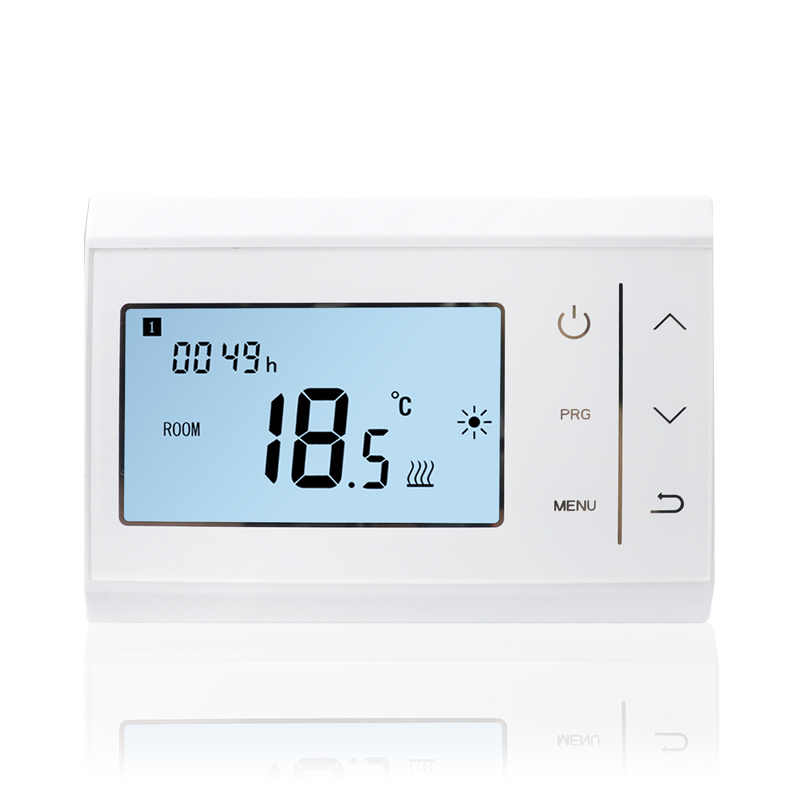
With the popularization of smart home and energy-efficient building concepts, smart thermostats have gradually become an indispensable device in homes, office buildings, and various public spaces. Compared to traditional thermostats, smart thermostats can not only accurately regulate indoor temperature but also learn usage habits and link with air conditioning or heating systems to achieve more efficient and comfortable environmental control. However, many users find that the thermostat’s temperature control effect is not ideal after installation: either the indoor temperature fluctuates greatly, or the air conditioner or heater frequently starts and stops, or there is even a significant deviation from the actual human sensation. The reason for this, besides the performance of the device itself and the system settings, is often the most easily overlooked yet extremely crucial factor: the appropriateness of the installation location. A smart thermostat essentially “determines” whether to adjust air conditioning or heating equipment by sensing the surrounding ambient temperature. If its location does not accurately reflect the average room temperature, even the most advanced algorithms will be ineffective. Therefore, clearly defining the appropriate installation location for a smart thermostat and avoiding common pitfalls not only affects living comfort but also directly impacts energy efficiency and the device’s lifespan.
Representative Location for Indoor Temperature Measurement
The most important function of a smart thermostat is to sense ambient temperature; therefore, its installation location must be representative. “Representative” does not refer to the coolest or hottest spot, but rather to the average temperature in areas where most people are active most of the time. The thermostat should be installed near frequently used areas within the room, such as the central wall of core spaces like the living room or bedroom. Airflow is relatively stable in these areas, and temperature changes more closely reflect the overall spatial conditions. Installing the thermostat in a remote or peripheral location can easily lead to distorted temperature measurements, affecting the system’s judgment. Furthermore, the thermostat should be avoided in areas with frequent temperature fluctuations, such as near doors, windows, or hallway entrances. These areas are easily affected by outdoor air temperature changes and do not represent the overall indoor temperature level.
Appropriate Installation Height
Installation height is another key factor affecting the accuracy of smart thermostat measurements. Locations that are too high or too low will produce deviations due to air temperature stratification. It is generally recommended to install the thermostat on a wall within the range of human activity height to ensure that the measured temperature is closer to what people actually feel. A low installation height makes the thermostat susceptible to the effects of cold air or heat radiation from the ground, while a high installation height makes it more prone to sensing rising hot air, leading to an imbalance in room temperature readings. A suitable installation height not only improves comfort but also prevents frequent starting or stopping of air conditioners, underfloor heating, and other equipment due to misjudged temperatures. In the long run, it also contributes to energy conservation and stable system operation.
Keep Away from Heat Sources, Cold Sources, and Areas with Strong Interference
Smart thermostats are highly sensitive to their surroundings and must be kept away from factors that may interfere with temperature sensing. Common sources of interference include air conditioner vents, radiators, fireplaces, electrical appliances, and areas exposed to direct sunlight. If the thermostat is installed near these locations, it is easily affected by localized high or low temperatures, causing the system to mistakenly believe that the entire room has reached the set temperature, thus prematurely stopping or delaying its adjustment. This not only reduces comfort but may also increase energy consumption. It is also important to note that spaces with frequent temperature and humidity fluctuations, such as kitchens and bathrooms, are generally unsuitable as installation locations for thermostats in the whole house or main areas. These locations should be appropriately chosen based on actual control needs.
Comprehensive Judgment Based on Spatial Layout and Usage Habits
Different building structures and usage scenarios require different installation locations for smart thermostats. Open-plan spaces, duplexes, and multi-room layouts all require comprehensive consideration within the overall spatial logic. For example, in an open-plan living and dining room, the thermostat should ideally be installed in a location that is visually and centered in terms of airflow. In multi-room structures, it’s necessary to clearly define the primary area the thermostat serves to avoid temperature perception discrepancies caused by “one thermostat controlling multiple rooms.” Furthermore, users’ daily routines and main activity areas should also be taken into account in the installation decision. A smart thermostat isn’t simply “installed and automatically becomes smart”; only when it matches the actual lifestyle can it truly realize its intelligent regulation value.
The installation location of a smart thermostat is not arbitrary but a systematic issue that requires consideration of environmental perception, spatial layout, and usage needs. A suitable installation location should accurately reflect the overall indoor temperature, avoid the influence of localized hot or cold sources and external interference, and be within a reasonable height range, close to the actual comfort level of the human body. Proper installation not only enhances the comfort of living or working environments but also reduces inefficient operation of air conditioning and heating systems, improves energy efficiency, and extends the overall lifespan of equipment. Conversely, neglecting the importance of installation location will make it difficult to achieve ideal temperature control, even with the most feature-rich and algorithmically advanced smart thermostats. Therefore, thermostat installation should be considered a crucial step in the planning and implementation of smart home systems, with a reasonable layout planned in advance based on the spatial structure and usage scenarios. Only when installed correctly can the intelligent advantages of a smart thermostat be truly realized, providing users with a stable, comfortable, and efficient temperature control experience.