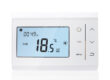
As a core component of modern heating systems, the boiler thermostat’s stable operation directly affects the reliability of home heating and hot water supply. When the E1 error code suddenly appears on the device’s display, most users experience anxiety—behind this seemingly simple number lies a complex chain of failures. From abnormal gas supply to circuit board malfunctions, from ignition system failures to sensor misjudgments, E1 errors are often the result of multiple intertwined factors, requiring a systematic troubleshooting approach to accurately pinpoint the root cause.

The stability of the gas supply system is the primary factor causing E1 errors. During peak winter heating seasons in northern regions, gas pipeline pressure fluctuates frequently. When the pressure drops below 2000Pa, the gas cannot form an effective mixture with air, leading to ignition failure. Repair cases of a certain brand of wall-hung boiler show that 32% of E1 failures originate from insufficient gas meter battery power causing valve closure, while 15% of cases are due to clogged gas pipeline filters leading to reduced flow. It is worth noting that some users use inferior gas to save costs, and the excessive impurities in this gas accelerate the wear of solenoid valves. One repair team once cleaned particles as large as 2mm in diameter from a faulty solenoid valve. These hidden dangers accumulate gradually over long-term operation, eventually triggering the protection mechanism.
Physical wear of the ignition system is another common cause. As the generator of the high-voltage electric spark, the ignition electrode’s surface oxide layer thickness exceeds 0.1mm, resulting in a more than 40% reduction in discharge energy. A repair organization inspected 500 faulty devices and found that 68% of the ignition electrodes had carbon buildup, with 23% of the electrode heads worn by more than 30% of their original diameter. The decreased sensitivity of the flame sensor is also significant. When its surface is covered with oil, the flame detection response time increases by more than 0.5 seconds, causing the system to misjudge ignition failure. A brand’s technical documentation clearly states that the distance between the flame sensor and the burner should be strictly controlled within 3±0.5mm; a deviation exceeding 1mm may trigger an E1 alarm.
Hidden faults in the circuit control system are often deceptive. As the “brain” of the equipment, the main control board’s printed circuit board is prone to solder joint defects under prolonged high-temperature environments. During the repair of a certain model of wall-hung boiler, it was found that the resistance of the resistor controlling the ignition signal drifted to three times the standard value, causing the solenoid valve to fail to open properly. Motor failures in proportional control valves are more insidious; when the valve core is stuck at 15% opening, insufficient gas flow will trigger continuous ignition attempts. One device triggered overheat protection after 12 repeated ignition attempts within 3 minutes. Aging of the diaphragm in the air pressure switch is also a concern; when the suction pressure reaches -30Pa, it cannot conduct properly, causing the system to misinterpret it as a ventilation abnormality.
A systematic solution for E1 errors should follow the principle of “starting with the easy and progressing to the difficult.” Novice users can prioritize checking the gas meter battery level, valve opening, and pipe filter; these operations can be performed without specialized tools. For users with some hands-on experience, further checks can be made on the ignition electrode spacing (measured using calipers) and the flame sensor needle (polished with 600-grit sandpaper). If the above steps are ineffective, a multimeter should be used to check the resistance of the solenoid valve coil (standard range 30-50Ω) and the on/off status of the air pressure switch. If main control board repair is involved, it must be performed by a professional holding a “Gas Appliance Installation and Repair Technician Certificate.” One repair company suffered direct economic losses exceeding 50,000 yuan due to a gas leak caused by a user replacing the circuit board themselves.
Preventative maintenance is key to reducing the E1 failure rate. It is recommended to clean the gas filter before each heating season and use professional equipment to check the gas pressure fluctuation range. In areas with excessive water hardness, water softening devices should be installed to prevent scale buildup on the solenoid valve core. Data from a research institution shows that equipment undergoing regular maintenance has a 73% lower E1 failure rate than unmaintained equipment. During equipment selection, prioritize products with intelligent diagnostic functions. For example, a certain brand’s new wall-hung boiler can monitor 12 key parameters in real time and send warning messages to the user’s mobile phone 3 days before a failure occurs.
When the boiler thermostat illuminates an E1 error, it is both a distress signal from the equipment and a litmus test for the user’s maintenance awareness. From minor blockages in gas pipelines to nanoscale solder joints on circuit boards, every link can become a potential source of failure. By establishing a systematic troubleshooting approach and implementing scientific preventative measures, users can not only quickly resolve current problems but also extend equipment lifespan by more than 30%. This heating season, let professionalism and meticulousness work together to build a warm defense, and let the E1 error become an opportunity to improve home safety.