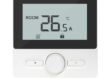
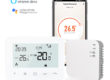
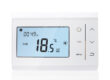
When a boiler continues to heat after the thermostat has set the temperature or fails to start at all, this “non-responsive” fault often stems from sensor failure, control circuit malfunction, or actuator jamming. A heating company encountered a similar case: during the peak winter heating season, the boiler water temperature in a certain residential area continuously soared to 95℃ (set value 70℃), causing frequent pressure releases from the safety valve. The investigation ultimately revealed that the thermostat probe was covered in scale, causing a 25℃ deviation between the measured value and the actual water temperature. This case illustrates a typical path to thermostat command failure: sensor signal distortion → control module misinterpretation → abnormal actuator operation.

Sensor Layer: Accurate Data Acquisition is the Foundation of Control
温控器的核心功能是通过温度传感器实时采集水温数据。如果传感器安装不当(例如,靠近进水口或加热元件),或者探头表面沾有水垢或油污,测量值就会与实际值产生偏差。酒店锅炉维护记录显示,30%的温控器故障源于传感器安装错误——将探头直接插入加热元件附近,导致局部过热并触发误报。此外,传感器老化也是一个常见问题。某品牌锅炉的实际测试数据显示,铂电阻传感器使用5年后电阻偏差率可达8%,远远超过±1%的允许误差范围。故障排除时,应使用万用表测试传感器的输出信号。如果测量值与实际水温偏差超过5℃,则需要更换传感器或清洁探头表面。
Control Module Layer: The Hub of Logic Judgment and Signal Transmission
The thermostat’s control module is responsible for converting sensor signals into execution commands. If the module program has vulnerabilities (such as unreasonable alarm threshold settings) or the power supply voltage is unstable (such as voltage fluctuations exceeding ±10%), it will lead to abnormal command output. In a case study of a chemical plant’s boiler control system evaluation, the evaluation team found by retrieving historical DCS data that the control module would erroneously trigger the “high temperature protection” program and force a shutdown when the voltage fluctuated to 200V (rated 220V). Furthermore, loose wiring or electromagnetic interference are also common hidden dangers. Actual test data from a hospital boiler room shows that signal lines without shielding can introduce interference pulses as high as 50mV when the frequency converter is running, causing the control module to malfunction. During troubleshooting, the stability of the module’s power supply should be checked, and signal line interference should be monitored with an oscilloscope. If necessary, rewiring and adding shielding should be done.
Actuator Layer: The Final Link in Command Implementation
The thermostat’s actuators (such as electric valves and frequency converters) are responsible for adjusting the heating power according to control commands. If the actuator is stuck or has a delayed response, the actual boiler temperature will deviate from the set value. Statistics from a heating company show that 45% of thermostat failures originate from electric valve malfunctions—the valve core is stuck by impurities, resulting in insufficient opening, or the motor burns out, causing complete failure. In addition, improper frequency converter parameter settings can also affect the execution effect. For example, the default acceleration time of a certain brand of boiler’s frequency converter is 30 seconds; setting it to 5 seconds will cause the motor to overload and trip. During troubleshooting, the electric valve should be manually operated to observe whether its opening and closing is smooth; a clamp meter should be used to test the frequency converter’s output current to confirm that it matches the control command.
System Collaboration: Multi-dimensional Verification and Preventive Maintenance
Troubleshooting thermostat command failures requires consideration of the overall system operating status. For example, if a boiler simultaneously triggers both “overheating” and “abnormal water level” alarms, it may be due to a signal conflict between the water level sensor and the thermostat, causing control malfunction. In a case from a food factory boiler room, the assessment team discovered through simulation experiments that when the water level falls below the safe value, the control system prioritizes triggering “shutdown protection,” ignoring the thermostat’s heating commands. Furthermore, regular maintenance is crucial for preventing malfunctions. It is recommended to clean sensor probes and check wiring tightness quarterly, and calibrate control module parameters and replace aging components annually.
Troubleshooting boiler thermostat command failures requires following the logical chain of “sensor → control module → actuator,” combining measured data with historical records to pinpoint the fault location. From scale-covered sensors to voltage-fluctuating control modules, from stuck electric valves to mismatched frequency converters, abnormalities in any link can lead to system malfunction. Through systematic troubleshooting and preventative maintenance, not only can current faults be quickly resolved, but the stability and safety of boiler operation can also be improved, providing reliable assurance for winter heating or industrial production.