
-white.jpg)
-2.jpg)
Against the backdrop of a growing global trend towards energy conservation, emission reduction, and low-carbon buildings, green and energy-saving buildings have gradually shifted from a “concept choice” to a “must-have solution.” Whether it’s hotels, apartments, student dormitories, retirement communities, or medical buildings, all are required to fully consider energy efficiency, operating costs, and long-term environmental impact during the design phase. Among numerous energy-saving measures, the HVAC system remains crucial, as it often accounts for the largest proportion of a building’s total energy consumption. If the control methods are inadequate, even with highly efficient equipment, it’s difficult to truly achieve green goals.
It is precisely under these real-world demands that the value of PTAC thermostats in green and energy-saving buildings is becoming increasingly apparent. It is not merely a temperature regulating device, but a vital node connecting users, equipment, and management systems. Through refined control logic and room-level management, PTAC thermostats help buildings use energy “only when needed, only in the necessary spaces,” reducing unnecessary consumption. This user-centric control philosophy aligns perfectly with the energy-saving, environmentally friendly, and efficient operation goals advocated by green buildings. Compared to traditional centralized control systems, PTAC thermostats offer significant advantages in energy management flexibility, operational efficiency, and user behavior guidance. The following is a systematic analysis of their application value in green and energy-efficient buildings from multiple dimensions.
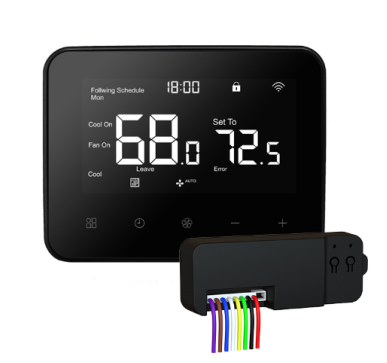
Space-Level Control
Green buildings emphasize “avoiding waste,” and the most significant feature of PTAC thermostats is their ability to refine energy consumption control down to the individual room level. Each room operates independently, different spaces are configured differently, and empty rooms do not require continuous cooling or heating. This space-level control method avoids the energy waste of traditional systems that operate on an entire floor but are only partially used, truly linking energy consumption to the usable area and usage time.
On-Demand Energy Supply
In the concept of green buildings, “on-demand energy supply” is one of the core principles. PTAC thermostats support multiple triggering mechanisms: manual start, door card linkage, human detection, and timed start/stop. The system only enters normal operation when a room is in use. In idle states, it automatically reduces power or shuts down, reducing ineffective energy consumption at the source. This operating principle significantly improves energy utilization efficiency.
Temperature Boundary Management
Many energy wastes stem from inappropriate temperature settings. PTAC thermostats allow administrators to preset: minimum cooling temperature; maximum heating temperature; and a reasonable comfort range. This avoids high-load operation caused by extreme temperature settings without affecting human comfort. This is a form of “guided energy saving,” effectively controlling energy expenditure without forcibly restricting the user experience.
Reducing Carbon Emissions
In green buildings, equipment energy efficiency ratios are just as important as carbon emissions. PTAC is often used in conjunction with heat pump technology, offering advantages such as integrated cooling and heating, high heating efficiency, and reduced use of electric heating. Heat pumps significantly improve the effective utilization rate of unit electricity by transporting heat rather than directly heating it, thereby reducing overall electricity consumption and indirect carbon emissions.
Reducing Transmission Losses
Centralized air conditioning systems inherently suffer from energy loss problems:
Pipeline transmission losses
Power consumption of water pumps and fans
Large system start-up and shutdown inertia
PTAC directly generates cooling and heating at the room terminals:
No long-distance transmission
No centralized power equipment
Instant on/off
Reducing energy consumption from the system structure is an “invisible but long-term effective” energy-saving method.
Behavioral Guidance
Green building not only focuses on equipment efficiency but also emphasizes user behavior. PTAC thermostats, through their interface and design principles, provide prompts for energy-saving modes, default reasonable temperatures, and automatic restoration to energy-saving states. This subtly guides users to develop energy-saving habits, rather than relying entirely on manual management. This “soft intervention” is a crucial aspect of green building.
Quantifiable Energy Savings
Effectiveness of energy saving must be proven by data. Many PTAC thermostats support: operating status recording; usage time statistics; energy consumption data collection; and abnormal status alarms. Managers can evaluate the effectiveness of energy-saving measures based on real data and continuously optimize operating strategies. Quantifiability and traceability are the foundation of green building management.
Low Cost of Green Upgrades
Many green buildings are not new constructions but upgrades of existing buildings.
PTAC thermostats offer:
Flexible installation
Minimally invasive structural modifications
No reliance on complex machine rooms
In old building renovations, energy-saving upgrades can be quickly achieved without large-scale demolition and alteration, reducing resource consumption during the renovation process.
PTAC thermostats transform energy management from a centralized, extensive model to precise room-level control, ensuring energy is used only when truly needed. This control logic aligns perfectly with the core principles of green building: reducing waste, increasing efficiency, and emphasizing user participation. Furthermore, PTAC thermostats utilize multiple methods, including temperature boundary management, efficient heat pump heating, structural reduction of transmission losses, and data traceability, to construct a sustainable energy-saving operating system. In practical applications, it not only helps buildings reduce operating energy consumption and carbon emissions but also provides managers with a clearer and more controllable approach to energy management. Because of these comprehensive advantages, PTAC thermostats are becoming an indispensable and crucial component of green and energy-efficient buildings.