


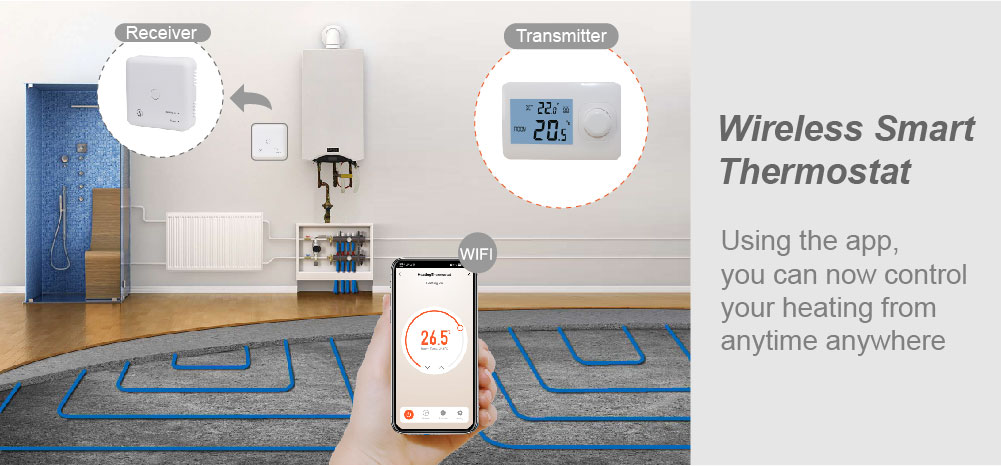
In underfloor heating systems, the laying method of the underfloor heating pipes is often overlooked by ordinary users. Many people believe that as long as the pipe materials are qualified and the heat source is reliable, the underfloor heating effect will not differ much. However, in actual use, the uniformity of floor temperature between different rooms and different areas within the same room, as well as the reasonableness of the heating rate, are largely related to the laying shape of the underfloor heating pipes. Among them, the “U-shaped” and “serpentine” patterns are currently the two most widely used laying methods, and are also the areas where many homeowners have the most questions when decorating or consulting about underfloor heating solutions. While the “U-shaped” and “serpentine” patterns look obviously different, their essential differences are not only reflected in their shapes, but also in the different ways of heat distribution, utilization of the supply and return water temperature difference, and construction logic. Choosing which one to use is not simply a matter of “which is more advanced” or “which is more economical,” but requires a comprehensive judgment based on the room area, spatial structure, heat demand, and system design goals. Blindly choosing a method without understanding its characteristics can easily lead to uneven heating or unsatisfactory energy efficiency.
What is a “U-Shaped” Underfloor Heating Pipe Installation?
The “U-shaped” installation, also known as a “parallel spiral” or “spiral” installation, refers to the underfloor heating pipes being laid from the edge of the room, gradually advancing towards the center, and then spiraling outwards at similar intervals, forming a structure resembling the Chinese character “回” (hui, meaning “return”) or a spiral. A significant characteristic of this installation method is that the supply and return pipes are spatially intertwined and close to each other. Because the supply water temperature is higher and the return water temperature is relatively lower, their alternating distribution beneath the floor helps to balance the overall floor temperature, resulting in a more even heat distribution. From a thermal perspective, the “U-shaped” installation is more effective in mitigating the impact of temperature differences between the supply and return water.
What is a “Snake-Shaped” Underfloor Heating Pipe Installation?
The “snake-shaped” installation is an earlier and widely adopted method. Its characteristic is that the underfloor heating pipes start from one side and are laid continuously in an “S” shape along the length or width of the room, finally ending on the other side. The entire pipe route is relatively straightforward, with the supply and return ends located at opposite ends of the room. This laying method has a simple structure and clear construction logic, making it easier for installers to operate and allowing for flexible adjustments in narrow or irregularly shaped spaces. However, from a heat distribution perspective, because the supply and return water are relatively separated spatially, the area near the supply end tends to be warmer, while the area near the return end is relatively cooler.
Comparison from the perspective of floor temperature uniformity
One of the core aspects of underfloor heating comfort is the uniformity of floor temperature. From this perspective, the “U-shaped” laying pattern is generally more advantageous. Because the supply and return water are staggered, heat diffuses more evenly under the floor, effectively reducing the “hotter at the front, colder at the back” phenomenon. In contrast, the “serpentine” laying pattern is more likely to create a temperature gradient, especially when the single loop is long, making the temperature difference between the supply and return ends more pronounced. This difference may manifest as one side of the room feeling warmer underfoot and the other slightly cooler.
Differences from Construction and Design Perspectives
From a construction perspective, the “serpentine” laying pattern, due to its intuitive direction and regular turns, requires relatively less construction experience and is faster to install. Therefore, it is still used in some projects where cost and schedule are critical. The “U-shaped” laying pattern, on the other hand, requires more precise planning during the design phase, including pipe spacing control and center position reservation, and has higher requirements for construction standardization. However, precisely because its planning is more rigorous, it is also easier to achieve the expected thermal performance.
The Impact of Space Type on Laying Method Selection
Different spaces have different adaptability to underfloor heating laying methods. Larger, more regularly shaped spaces are better suited to the advantages of the “U-shaped” laying pattern, ensuring even heat distribution throughout the area. In narrow spaces or rooms with significant local heat load differences, the “serpentine” laying pattern is easier to adjust flexibly according to the space structure, reducing the construction difficulties caused by excessive pipe bends. Therefore, the choice of laying method should serve the specific space, rather than being a one-size-fits-all approach.
System Design Philosophy Determines “Good” or “Bad”
There is no absolute superiority or inferiority between the “U-shaped” and “serpentine” laying patterns. They are simply products of different design philosophies. The “U-shaped” pattern emphasizes comfort and uniformity, while the “serpentine” pattern emphasizes simplicity of construction and adaptability. Under the premise of reasonable loop length, pipe spacing control, and overall system design, both laying methods can meet basic heating needs. The key lies in whether it matches the overall underfloor heating solution.
The “U-shaped” and “serpentine” patterns in underfloor heating pipe laying are not simply a matter of “which is better,” but rather “which is more suitable.” From the perspective of floor temperature uniformity, the “U-shaped” laying pattern, due to the staggered distribution of supply and return water, is more conducive to achieving overall comfortable and stable heating effects, especially suitable for larger spaces with high comfort requirements. The “serpentine” laying pattern, with its simple structure and flexible construction, still has practical value in narrow or irregular spaces and is easier to control construction costs and difficulty. As long as the loop length and pipe spacing are reasonably controlled during the design phase, its heating effect can also meet daily needs.