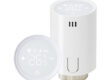
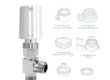
In the depths of winter, when radiators become the guardians of warmth in your home, have you ever been troubled by uneven indoor temperatures and excessive energy consumption? In traditional heating systems, users often have to manually adjust the valve opening to control room temperature, but this method is neither precise nor able to cope with real-time changes in outside temperature. The thermostatic radiator valve was developed precisely to solve this problem. It not only makes indoor temperature control intelligent and efficient but also becomes an “invisible guardian” of home energy conservation and emission reduction.

Thermostatic Valve: The “Smart Brain” for Precise Temperature Control
The core of the thermostatic radiator valve lies in its built-in temperature-sensing element—the thermostatic bulb. This precision device can sense changes in indoor temperature in real time and automatically adjust the hot water flow by physically expanding or contracting the valve core. For example, when sunlight shines through the window and raises the room temperature, the thermostatic bulb will quickly respond by closing the valve opening to reduce hot water input; conversely, when the temperature drops sharply at night, the valve will automatically open wider to ensure that warmth is not lost. This “on-demand heating” mechanism keeps the room temperature stable within the user’s set comfort range, completely eliminating the awkward experience of “fluctuating temperatures.”
More importantly, the energy-saving effect of thermostatic valves is remarkable. Taking a typical household as an example, adjusting the room temperature from 22℃ to 20℃ can reduce energy consumption by about 10%. Furthermore, through the intelligent adjustment of the thermostatic valve, the system can fully utilize “free heat energy” such as sunlight and appliance heat dissipation, further reducing boiler operating time. Data shows that after installing a thermostatic valve, household heating energy consumption can decrease by an average of 15%-30%. Over the long term, the savings in gas or electricity bills are sufficient to cover the equipment cost.
Compatibility: Full Coverage from Two-Pipe to Single-Pipe Systems
Many users worry about whether thermostatic valves are compatible with their heating systems. In fact, modern thermostatic valves have been designed with diverse solutions for different piping systems. In two-pipe systems, high-resistance thermostatic valves can effectively balance the flow of air in different floors and rooms, avoiding vertical imbalance problems such as “overheating in the upper floors and undercooling in the lower floors.” In single-pipe systems, precise temperature control can also be achieved by adding a bypass pipe and using a low-resistance thermostatic valve. For example, the H-type thermostatic valve is specifically designed for bottom-inlet, bottom-outlet radiators. Its 50mm standard interface spacing and bypass flow adjustment function make retrofitting older systems easy and feasible.
Installation details to note: The thermostatic valve must be fixed horizontally at the radiator inlet, and a filter should be installed at the front end to prevent welding slag blockage; the temperature sensor must be exposed to air circulation and not obstructed by curtains or furniture, otherwise it may cause malfunction. In addition, users can adjust the set temperature by rotating the 0-5 scale on the handle. It is recommended to initially set it to “5” (maximum flow) and then fine-tune it according to actual needs, which can quickly raise the temperature while avoiding energy waste.
User Testimonials: From “Makeshift” to “Refined” Heating Upgrades
In a renovation case in a northern community, 300 households uniformly installed thermostatic valves. After one heating season, residents reported that room temperature fluctuations decreased from ±3℃ to ±0.5℃, eliminating the need for frequent valve adjustments during nighttime sleep; property management statistics showed that the community’s overall energy consumption decreased by 22%, and due to improved system hydraulic balance, the boiler failure rate decreased by 40%. One elderly person living alone remarked, “I used to worry that turning off the valve would freeze the pipes, but now with the 8°C anti-freeze mode, I can go out for a month without worry, and I’ve even saved nearly a third on my heating bill!”
The Future is Here: Thermostatic Valves Lead a New Trend in Green Heating
With the advancement of “dual-carbon” goals, energy conservation in homes has become a social consensus. Thermostatic radiator valves, with their “small device, big energy” characteristics, are moving from high-end residences to ordinary households. Some local governments have introduced subsidy policies to encourage residents to upgrade their heating systems to be more intelligent. It is foreseeable that in the future, thermostatic valves will be deeply integrated with IoT technology, allowing for remote temperature control via mobile apps and adjustment with smart thermostats, making heating management more convenient and efficient.
For users still hesitant about installing thermostatic valves, consider the long-term benefits: a set of thermostatic valves costs only a few hundred yuan, but the annual energy savings can reach thousands of yuan; more importantly, the comfort and environmental contribution it brings to the family is immeasurable. In this era that values quality and sustainability, thermostatic radiator valves are no longer just “optional accessories,” but essential tools for improving heating quality and practicing green living. Choosing a thermostatic valve means choosing a warmer, more energy-efficient, and smarter future.